

SpaceX shares climbed more than 10% after hours on Tuesday following a substantial earnings beat that reshaped the investment case for the company. Third-quarter revenue reached $14.6 billion, up 161% from a year earlier and comfortably above expectations of $12.9 billion, offering stronger evidence that its investment in computing infrastructure is beginning to generate significant sales. The scale of the beat immediately reframed the debate about whether heavy capital spending can translate into durable revenue growth. Coming into the report, the central question for the stock had been whether the money pouring into data-centre capacity would eventually show up as revenue, or whether it would simply accumulate as depreciating assets that never earn an adequate return. The quarter answered that question forcefully, and it did so at a speed that few on the sell side had anticipated.
Net income reached $4.4 billion, reversing a $1.1 billion loss a year earlier and delivering SpaceX's first profitable quarter since going public. The swing matters because it demonstrates that the business can absorb enormous infrastructure outlays and still produce a positive bottom line, at least in quarters when revenue arrives on schedule. Investors will want to see whether the result marks the start of a durable earnings trend or a single strong print. Profits of this size give management room to fund the next stage of expansion internally instead of leaning entirely on outside financing, which matters in a quarter when the spending plan is growing rather than shrinking. The caution is that the quarter benefited from revenue arriving on time and costs that had not yet fully caught up with the build.
The Super Intelligence division generated $7.56 billion in revenue, up from $813 million a year earlier and representing 52% of total sales. It also recorded $431 million in operating profit, which suggests the AI business is scaling faster than many analysts had modelled. The division's growth rate underscores how quickly the company's revenue mix has shifted toward computing and away from its traditional launch operations. A year ago the segment was a rounding error in the accounts; today it is the single largest source of revenue in the group. That kind of change in a single year is unusual outside of a genuine technology shift, and it means the company's fortunes are now far more closely tied to demand for computing capacity than to the launch cadence that built the business. The operating profit figure is smaller than the revenue line, which is expected for a division still absorbing heavy depreciation, but the direction is what matters.
SpaceX's identity is changing rapidly, with computing now producing more revenue than its satellite and launch businesses combined. That transformation carries both opportunity and risk: the AI operation is growing faster, but it is also more capital-intensive and more exposed to competition from established cloud providers. The market is being asked to value a company whose earnings base is being rebuilt around a business that did not exist at this scale a year ago. Incumbent providers have deep relationships, existing data centres and pricing power built over years, and none of them will concede a share of the market without a fight. SpaceX has an advantage in speed, in the integration of its own satellite network, and in the willingness to commit enormous sums before demand is fully proven, but those advantages are not permanent. If competitors match the pace of deployment, the division's pricing and profitability could compress.
Starlink remains an important profit engine. The Connectivity division produced $5.2 billion in revenue and $2.4 billion in operating income, with consumer subscribers reaching 13.6 million. That recurring business gives investors an established source of earnings alongside the faster-growing, more capital-intensive AI operation, and it provides the cash generation that helps fund the broader expansion. Consumer broadband subscriptions are sticky in a way that wholesale computing contracts are not: customers pay month after month, churn is comparatively low, and the revenue arrives without the same lumpiness that comes from signing a large enterprise deal. The division's operating income is a large share of group profit, which is why any slowdown in subscriber additions would matter far beyond the segment itself. For now the subscriber count is still climbing, and that steady compounding business is the part of the company that analysts understand best.
Quarterly capital expenditure reached $19.6 billion, including $16.4 billion in the AI division. Those investments purchase infrastructure expected to serve customers over several years, which is why the spending is best judged against future revenue rather than current earnings. The pace of deployment will determine how quickly the division can convert its order pipeline into billable capacity. Roughly four fifths of the quarter's outlay went into the computing business, which tells investors where the company believes the highest returns lie. The risk in spending at this rate is not that the money disappears, but that capacity arrives before customers are ready to use it, leaving expensive equipment idle for a period. The flip side is that the companies which build fastest in this environment often end up with the best unit economics, because early capacity can be filled at premium pricing while competitors are still ordering hardware.
Across the first nine months, operating cash flow totalled $13.1 billion against $48.1 billion of capital expenditure. Subtracting those figures leaves a roughly $35 billion gap before other investing and financing movements, a gap that highlights how much external funding the current buildout requires. Investors will be watching whether operating cash flow can close that gap as the AI division scales. The gap exists because the company is spending roughly three and a half dollars for every dollar it collects from customers, and closing it depends on two things: revenue growing fast enough to outrun the spending, and spending eventually levelling off as the build matures. Neither is guaranteed, which is why the funding question stays at the centre of the debate. What is clear is that the company has chosen growth over near-term cash generation.
SpaceX nevertheless ended September with nearly $90 billion in cash, cash equivalents and marketable securities, which provides substantial funding capacity. The buffer means the company is not forced to raise capital at an inopportune moment, though the pace of spending will determine how long that cushion lasts. The balance sheet remains one of the strongest arguments for the stock at current valuations. A war chest of that size buys time and optionality: it allows the company to keep deploying capacity through a downturn in demand, to absorb a quarter where revenue disappoints, and to move quickly on an acquisition or a partnership without going to the market. It also means that a capital raise, if one comes, is more likely to be opportunistic than desperate. The counter-argument is that a balance sheet this large can encourage wasteful spending.
Management expects another $35 billion to $40 billion of capital expenditure in the fourth quarter, against Wall Street forecasts near $20 billion. It also projected first-quarter 2027 revenue of $33 billion to $37 billion, above expectations near $22 billion. The guidance gap is unusually wide, and it signals that management sees demand well beyond what analysts have modelled. A range this broad is rare for a company of this size, and it tells investors that management itself is uncertain about the pace at which new capacity can be filled. The revenue guide is equally striking: it implies the company expects to keep growing at a rate that would put the full year well ahead of the numbers the market was using. If the guidance proves accurate, the debate shifts from whether growth is real to whether the spending needed to sustain it is sustainable.
The spending outlook keeps cash generation at the centre of the investment debate. If the additional infrastructure can be brought into service quickly, the higher outlays should translate into revenue and eventually into operating efficiency. If deployment slips, the same spending could weigh on profitability and extend the period during which the company consumes more cash than it produces. The two scenarios share the same starting point and diverge only in timing, which is why execution is the whole story here. Watch the cadence of capacity coming online, the length of the sales cycle for new computing contracts, and whether operating cash flow starts to converge toward capital spending. Those three signals together will show whether the company is building a self-funding growth engine or simply burning through its balance sheet faster.
SpaceX and Tesla have formed independent board committees to evaluate a potential merger, Elon Musk confirmed. He supports the idea but is not participating in the deliberations because of his interests in both companies. The proposed rationale spans AI, chip design, robotics and satellite technology, which would combine two of the largest industrial and technology platforms in the United States. The structure of independent committees is designed to make sure the negotiation is conducted at arm's length rather than by a controlling shareholder with a stake in the outcome, and it is the standard safeguard in a deal of this kind. Nothing has been agreed, and the committees could conclude that the combination does not make sense. But the mere existence of the process is a catalyst, because it puts a potential transaction in front of two shareholder bases.
Investors would still need to assess the exchange ratio, governance and financial commitments of any combination, and those details would determine how the benefits and funding demands are shared between shareholders in the two businesses. Overall, the quarter delivered a decisive earnings beat and a much larger spending plan, leaving the market to weigh rapid growth against the cash it consumes and the extra optionality of a potential Tesla combination. The exchange ratio is the number that would decide most of the value: it sets how much of the combined entity each side owns, and therefore how much of the future cash flows and the future spending burden falls to each shareholder base. Governance matters as well, because the combined company would need a clear structure for allocating capital between two very different businesses. The quarter, in short, gave investors more to think about than a single earnings print.
Trading Insight
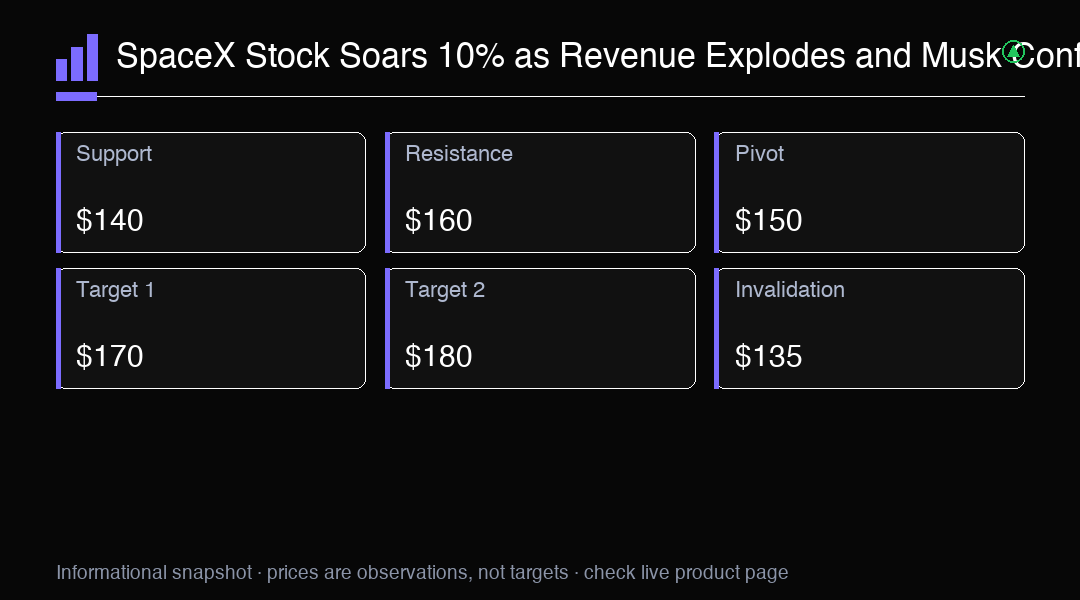
SpaceX surged more than 10% after hours on a 161% revenue jump to $14.6 billion and its first profitable quarter since going public. Key resistance at $160. Watch Q4 capex guidance and Tesla merger news.