


Gold traded at $4,171.40 per ounce on Monday, up 0.18% from the previous day, as the dollar softened and Treasury yields declined. The precious metal has now recovered from the recent low of $4,050 set earlier this month, gaining 2.4% over the past two weeks. The move extends a rebound that began after the metal found buyers in the low $4,000s, and it leaves gold trading comfortably above the levels that capped the market for much of September. Market participants described the tone as constructive rather than explosive, with the metal grinding higher in a series of short-covering rallies instead of surging on a single catalyst.
The gain follows a US producer inflation report that came in cooler than expected, easing concerns about aggressive Federal Reserve rate hikes. The dollar index fell 0.3% to 101.10, making gold cheaper for foreign buyers and boosting demand. Lower borrowing costs reduce the opportunity cost of holding non-yielding assets like gold. The pull in real yields was equally important, since gold competes with interest-bearing instruments for capital. With the dollar softening and yields drifting lower, the macro headwind that dominated September has eased, giving bulls room to test the upper end of the recent range.
Gold has now recovered from the recent low of $4,050 set earlier this month. The metal remains up 35% year over year, though it is down 4% from the all-time high of $5,608.35 set in January 2026. Key resistance is now seen at $4,200, a level that drew selling interest in late September. That round number has acted as a ceiling on three separate occasions this quarter, which is why traders are watching it closely. A clean break above it would mark a change in character for the market, whereas repeated rejections would reinforce the idea that supply remains plentiful near current levels.
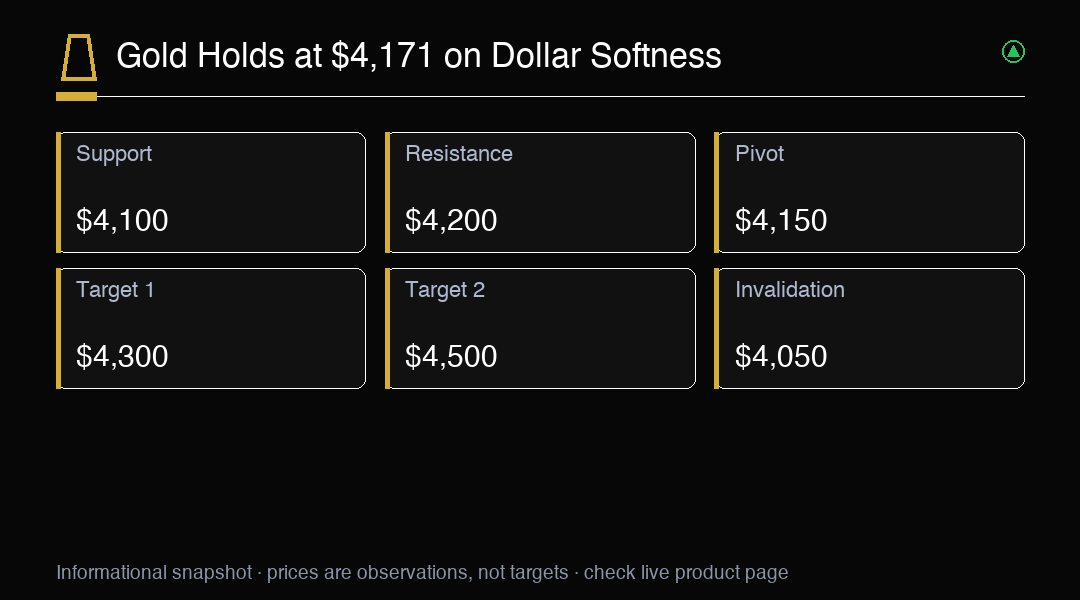
From a technical perspective, gold is testing a resistance zone between $4,150 and $4,200. A decisive break above $4,200 could open the door to a retest of $4,300. Conversely, a pullback below $4,100 would signal a return to the recent trading range. Momentum indicators have turned higher from oversold territory, and the moving-average structure is beginning to flatten after weeks of decline. The pattern suggests the market is consolidating rather than reversing, with each failed rally being absorbed and built upon. Traders typically look for a daily close, rather than an intraday spike, to confirm that the resistance zone has genuinely given way.
Silver also gained, rising 1.2% to $49.50 per ounce. The gold-silver ratio fell to 84.3, its lowest level in two months, suggesting silver is outperforming gold during the current bout of risk appetite. The narrowing ratio suggests industrial demand for silver is picking up. Silver is used across solar panels, electronics and industrial processes, so its performance is often read as a proxy for the health of global manufacturing. When silver leads, it tends to signal that buyers are reaching for cyclical exposure rather than simply seeking defensive shelter. That dynamic supports the broader metals complex, though it can also mean the move is more fragile if industrial data disappoints.
Analysts note that gold's recent strength is supported by a combination of factors. Rising government deficits, elevated geopolitical tensions and central bank buying should all provide support. The metal had struggled to gain traction earlier this month, but the latest inflation data provided a catalyst for the rebound. Portfolio managers describe gold as an insurance holding rather than a core growth position, which means demand tends to build gradually as macro uncertainty rises. That steady accumulation, rather than a single burst of speculation, is what tends to underpin durable rallies. It also explains why pullbacks have been shallow and why sellers have been reluctant to press positions aggressively.
The options market shows increased demand for call protection in gold, with implied volatility rising to 18.8%, up from 16.5% last week. Traders are paying more for upside exposure, reflecting optimism about further gains. However, put skew remains negative, suggesting some investors are still hedging against declines. The split positioning captures the two-sided nature of the market: bulls are chasing upside while bears refuse to abandon downside protection. That combination often precedes a breakout, since hedges get expensive and are either rolled or abandoned once the direction becomes clearer. Implied volatility at these levels remains historically contained, which suggests the market is not yet pricing a disorderly move in either direction.
Central bank buying continues to provide a floor under gold. The World Gold Council reported that central banks added 32 tonnes to reserves in September, with China, India and Poland leading the purchases. This follows record buying in 2024 and 2025 and suggests central banks remain committed to diversifying reserves away from the dollar. Official-sector demand is structurally important because it is price-insensitive over short horizons, meaning it does not reverse when the metal corrects. That behaviour gives the market a base of buyers who step in regardless of the daily price action, cushioning declines and reinforcing the long-term uptrend that has been in place since 2023.
Looking ahead, the busy earnings week could influence gold prices. If technology companies demonstrate that AI investments are generating returns, it could boost risk sentiment and weigh on precious metals. Conversely, disappointing results could push investors toward safe-haven assets like gold. The relationship is not perfectly linear, since gold can benefit from both inflation fears and growth fears. What matters for the metal is the direction of real yields and the dollar, both of which tend to move sharply when growth expectations are revised. Earnings that confirm a soft landing would probably cap gold near current resistance, while signs of a slowdown would favour the defensive bid.
Overall, gold remains in a broad range between $4,050 and $4,300 established over the past month. The combination of cooler inflation and dollar softness has provided near-term support, but sustained gains will likely require confirmation that the Fed is pausing its rate hikes. The earnings week will be a key test. Positioning suggests traders are neither panicked nor euphoric, with the market content to trade the range until a decisive catalyst arrives. For now, the metal is behaving like an asset in repair, recovering lost ground without yet demonstrating the momentum needed to challenge its record high.
Some analysts are now targeting $4,500 as the next major resistance level, arguing that the combination of ETF demand and macroeconomic uncertainty could drive gold to new highs by year-end. However, the near-term outlook remains dependent on the Fed's policy path and the dollar's direction. Those targets require a sustained break above $4,200 first, followed by acceptance above $4,300, which would open the measured-move path toward $4,500. Without that sequence, the metal is more likely to consolidate. The balance of evidence currently favours range-bound trading with a modestly positive bias, rather than a straight-line advance toward fresh records.
For traders, the setup is defined by a clear band of support near $4,100 and resistance clustered at $4,200. A daily close above $4,200 would shift the bias toward a test of $4,300, while a loss of $4,100 would reopen the door toward $4,050. The practical implication is that risk is best managed around these levels rather than in the middle of the range, where price action tends to be noisy and stop-hunting is common. Patience is likely to be rewarded as the market digests inflation data and the earnings calendar. Until a breakout is confirmed, the higher-probability trade is to respect the boundaries of the range and wait for the market to show its hand.
Trading Insight
Gold is testing $4,200 resistance after rebounding from $4,050 support. Watch earnings week for direction. Range remains $4,050 to $4,300.