


The Dow Jones Industrial Average climbed 530 points, or 1%, to 52,495.88 on Tuesday, outperforming its peers and extending a recovery that has drawn in a much wider group of stocks. The S&P 500 gained 0.3% to 7,712.57, while the Nasdaq Composite slipped 0.02%, and the divergence between the blue-chip benchmark and the technology-heavy index defined the session. Smaller companies joined the advance, with the Russell 2000 rising approximately 1.7%, and that kind of breadth is what strategists look for when they separate a durable recovery from a narrow rally carried by a handful of large technology names.
Healthcare reached a record as investors broadened their exposure, with financials, property stocks and utilities also advancing in a session that looked more like a rotation than a scramble for safety. Dow constituent 3M jumped 5.8% after expanding its data-center partnership with Amazon and raising its profit outlook, and the size of the move showed that individual company news can still drive sharp re-ratings even in a market lifted by broad sector rotation. Banks benefited from the same reassurance, since a steadier earnings backdrop tends to ease concerns about loan quality and capital returns, while rate-sensitive property and utility shares drew support as equity income looked more attractive relative to the alternatives.
Asia extended the recovery on Wednesday, with South Korea's Kospi gaining around 4%, Japan's Nikkei rising 1.3% and the broader regional index outside Japan advancing 1.5%, in a session that mirrored the improving tone in New York. S&P 500 futures added around 0.3% in early trading, suggesting some follow-through from Tuesday's broader US advance rather than a one-day burst of optimism that faded as soon as the next session began. The improvement in Asian sentiment reduced one of the main sources of risk that had weighed on global markets in recent weeks, and it helped stabilise the growth-sensitive currencies that trade in sympathy with regional equity performance.
Australia's NextDC delivered a sharp warning about AI infrastructure, plunging as much as 44% after power-network delays forced the company to defer approximately A$140 million of contracted revenue and to cut its outlook. The company also paused new developments, a decision that removed revenue it had already expected to recognise and prompted analysts to reassess the timeline for its expansion program. The collapse was a reminder that not every company exposed to the AI theme benefits equally, and that execution risk can overwhelm a strong demand narrative when the infrastructure required to deliver capacity fails to arrive on schedule.
SpaceX gained more than 10% after hours as quarterly revenue surged 161% to $14.6 billion and net income reached $4.4 billion, a result that reframed the debate about how quickly its infrastructure spending can translate into earnings. AI became its largest revenue business, while Starlink remained the leading profit generator, and the mix of a fast-growing computing operation alongside a mature satellite subscription business gave the company two distinct engines of growth. Capital spending reached $19.6 billion, keeping the cost of expansion central to the investment case and reviving enthusiasm for the broader AI trade.
Supermicro supplied another boost to AI sentiment, estimating quarterly revenue of $18.5 billion to $19.5 billion against its previous $14.5 billion to $15.5 billion forecast, a raise so large that it immediately reset expectations for the pace of demand. Shares jumped more than 10% after hours, extending a run that has made the server maker one of the more closely watched proxies for spending on artificial-intelligence infrastructure. The raised guidance reinforced the view that demand for AI infrastructure continues to run ahead of supply, which is supporting the valuations of companies across the semiconductor and server supply chain.
Netflix fell 6% after hours despite beating quarterly earnings expectations, a reminder that in the current environment a strong historical print is not enough on its own to support a share price. Its fourth-quarter outlook disappointed and the company cut its annual advertising revenue forecast to $2.7 billion from $3 billion, a reduction that investors read as a sign that the second growth engine was running behind schedule. The divergence between Netflix and SpaceX illustrated how much the market is rewarding growth acceleration while punishing any sign of deceleration, even in highly profitable businesses with large and loyal customer bases.
Meta and Tesla report after Wednesday's close, extending the test of technology spending and valuations that has defined the earnings season so far. Watch Meta's advertising performance and investment outlook, alongside Tesla's automotive profitability and autonomy plans, because both companies sit at the centre of the same capital-spending debate that has driven the AI trade. Musk also confirmed that independent committees are examining a potential SpaceX-Tesla merger, although no agreement has been reached, which adds an additional catalyst for both stocks.
The dollar index held near 101.80 after Tuesday's decline, with EUR/USD around $1.1230, GBP/USD near $1.3370 and USD/JPY around 158.30 yen, a configuration that left the yen as one of the more closely watched currencies in the market. The Australian dollar traded above $0.70 following an RBA warning about worsening inflation, a reminder that central banks in the region are still weighing the risk that price pressures prove more persistent than expected. France's political unrest and fiscal concerns remained an additional risk for the euro, keeping currency markets sensitive to European political developments and limiting the scope for a sustained recovery in the single currency.
Treasury markets stabilized, although US yields remained above 5%, a level that continues to shape how investors value equities and other risk assets. That combination leaves stocks facing two pressures: expensive energy can squeeze company profitability while elevated borrowing costs weigh on valuations, and neither pressure is easily offset by a single strong earnings report. The level of yields is likely to determine how much further the market can extend its recovery, particularly for growth-sensitive sectors whose valuations depend most heavily on expectations of earnings far into the future.
Gold slipped toward $4,118 while Bitcoin approached $83,000, showing that the equity recovery was producing different responses across assets rather than a uniform shift in risk appetite. The divergence suggests that investors are not simply buying risk across the board, but are rotating between equities and other asset classes depending on their view of inflation and interest rates. Gold's modest decline indicated that the metal was being treated more as a hedge against uncertainty than as a direct beneficiary of the improving equity mood, while Bitcoin's advance reflected continued interest in assets that some investors regard as an alternative store of value.
Overall, the Dow's 530-point advance reflected a broadening rally supported by strong earnings, improving Asian sentiment and renewed enthusiasm for AI infrastructure, and the breadth gave it more credibility than a narrow advance would have carried. With Meta and Tesla reporting after Wednesday's close and US yields still above 5%, the market has reason for caution even as the near-term momentum favours buyers. The coming results will test whether the earnings season can sustain the improved mood or whether the rally runs out of fresh catalysts.
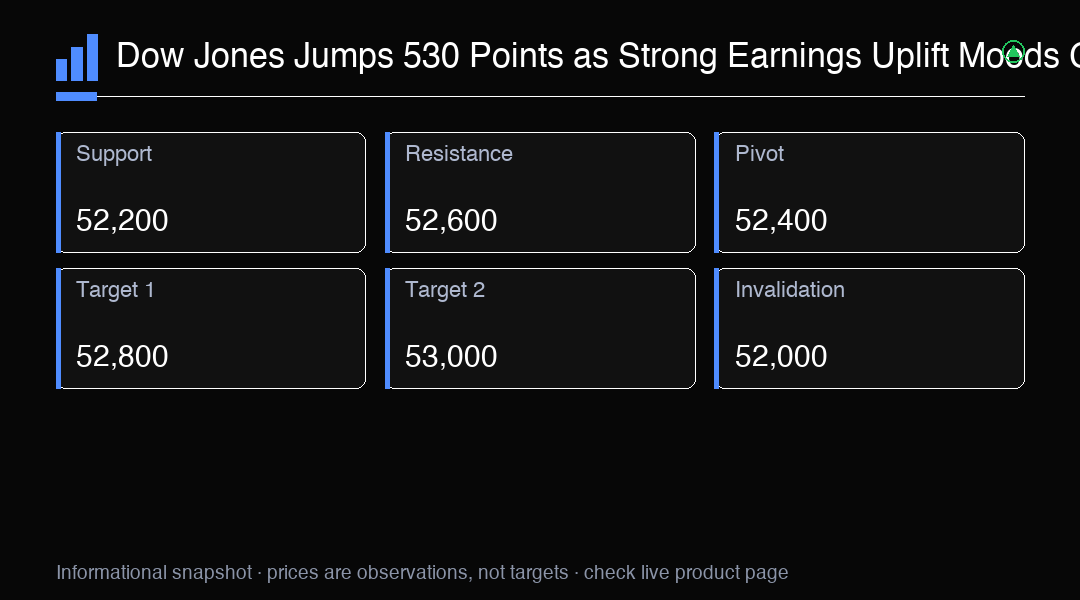
Trading Insight
The Dow jumped 530 points (1%) to 52,495.88 as the rally broadened beyond technology. Key resistance at 52,600. Watch Meta and Tesla earnings due Wednesday.