


The Nasdaq Composite climbed 1.05% to 26,702.86 on Wednesday, leading another positive session for US stocks as strong AI-related earnings helped investors look past concerns about the cost of the infrastructure buildout. The S&P 500 gained 0.6% to 7,757.17 and the Dow added 360 points, or 0.7%, to 52,856.09. The breadth of the advance suggested that the market was willing to reward companies that can demonstrate revenue growth from AI rather than simply promise it. Advancers outnumbered decliners and volumes ran above the recent average, which points to broad institutional participation rather than a narrow rally.
Thursday's futures suggested that confidence was back to being fragile. Nasdaq futures fell 1.1% and S&P 500 contracts slipped 0.5% in early trading as investors assessed the results from Meta and Tesla. The reversal showed how quickly sentiment can shift when the two most closely watched technology names deliver mixed messages, and it left the market facing a more cautious open. Futures reflect positioning rather than a forecast of the cash close, and the speed of the decline pointed to crowded trades being unwound quickly.
Brent crude climbed approximately 1.3% to $110.30, supported by renewed attacks in Saudi Arabia and the withdrawal of some US diplomatic personnel. The move in oil is the most immediate threat to the rally, because higher energy costs squeeze company profitability and strengthen expectations of tighter monetary policy. The combination of geopolitical risk and rising energy prices is a familiar headwind for equities, and it arrived just as investors were becoming more comfortable with the earnings season. Energy is an input cost for almost every business, so a sustained rise in crude complicates the inflation outlook.
SpaceX jumped 7.8% and Supermicro rallied 9.6% on Wednesday, providing much of the encouragement for the AI trade. SpaceX delivered its first profitable quarter since going public, while Supermicro's preliminary revenue and profitability outlook exceeded expectations. The two reports were the clearest evidence so far that the AI infrastructure buildout is beginning to generate measurable revenue, which is the argument that has sustained the sector through a period of heavy spending. That shift from promise to evidence changes the burden of proof for the sector.
Netflix, meanwhile, fell 5.3% during Wednesday's session following its disappointing profit outlook. The divergence between Netflix and the AI beneficiaries illustrated how selectively the market is allocating capital, rewarding growth acceleration while punishing any sign of deceleration. It is a reminder that the technology sector is not a single trade, and that stock-specific fundamentals now matter more than the broad AI narrative. A rising tide lifts most boats, but boats with a leak are still left behind.
Meta's revenue rose 26% to $64.6 billion, but quarterly capital expenditure reached $34.9 billion and free cash flow turned negative by $2.1 billion. The contrast between strong revenue growth and heavy cash consumption is the central tension in the AI investment debate. Investors are being asked to accept near-term cash burn in exchange for a position in what management describes as a generational technology shift. Spending at that level consumes cash faster than the core advertising business generates it, which raises the bar for the eventual return on investment.
Tesla reversed lower after its earnings call, falling more than 2% in late trading after gaining 3.4% during the regular session. The swing captured the market's uncertainty about how quickly the company can convert its autonomous-driving and robotics ambitions into revenue. The reversal also contributed to the softer tone in futures, because Tesla is one of the largest weights in the indices that lead the market. Index moves are capitalisation weighted, so a single heavily weighted name can offset gains across a much larger group of smaller companies.
Asia was mostly risk-off on Thursday, aligned with the futures mood on Wall Street. Japan's Nikkei fell 0.4% and South Korea's Kospi lost more than 1% in early trading. The weakness in Asian markets reinforced the cautious tone, and it suggested that the negative reaction to oil and to mixed technology earnings was spreading beyond US trading hours. The region is both a large importer of crude and a major producer of the semiconductors that feed the AI supply chain, so weakness in either channel can drag the benchmarks.
The Bank of Korea held its policy rate at 3%, although stronger growth and inflation projections suggested its tightening cycle may have further to run. The decision kept monetary policy in focus for Asian investors, and it added another reason for caution at a time when energy prices are already pushing inflation expectations higher. Central bank policy remains one of the main variables that could determine whether the global equity recovery can extend. Higher rates reduce the present value of the long-dated earnings that AI investments are expected to generate.
Sterling held near $1.34 after hotter UK inflation, while EUR/USD traded around $1.1240 and USD/JPY slid under 158 yen. France remained a concern for European assets after its 10-year government bond yield touched 5% on Wednesday. The combination of higher inflation and wider risk premiums in Europe is a reminder that the macro backdrop remains uneven, even as US technology earnings have been strong. Currency moves of this kind feed directly into the earnings of multinational companies.
Gold slipped back under $4,100, with higher energy prices complicating its appeal even when geopolitical uncertainty would normally encourage demand. The divergence between equities and gold showed that investors are weighing inflation and interest-rate expectations more heavily than safe-haven demand. That kind of dispersion is typical of a market that is still assessing whether the recent strength can be sustained. Gold usually rises when real yields fall, but energy-driven inflation pushes nominal yields higher and raises the opportunity cost of holding a non-yielding asset.
Overall, the Nasdaq's 1% advance reflected an AI-led rally supported by strong earnings from SpaceX and Supermicro, but futures turned sharply lower as oil jitters and mixed results from Meta and Tesla renewed caution. With Asian markets risk-off, US yields elevated and central banks signalling that tightening may not be finished, the near-term outlook favours a more selective approach. The coming sessions will test whether the AI trade can absorb higher energy costs or whether the rally needs fresh catalysts to continue. Support sits at 26,400 and resistance at 26,900, with 26,200 the invalidation level.
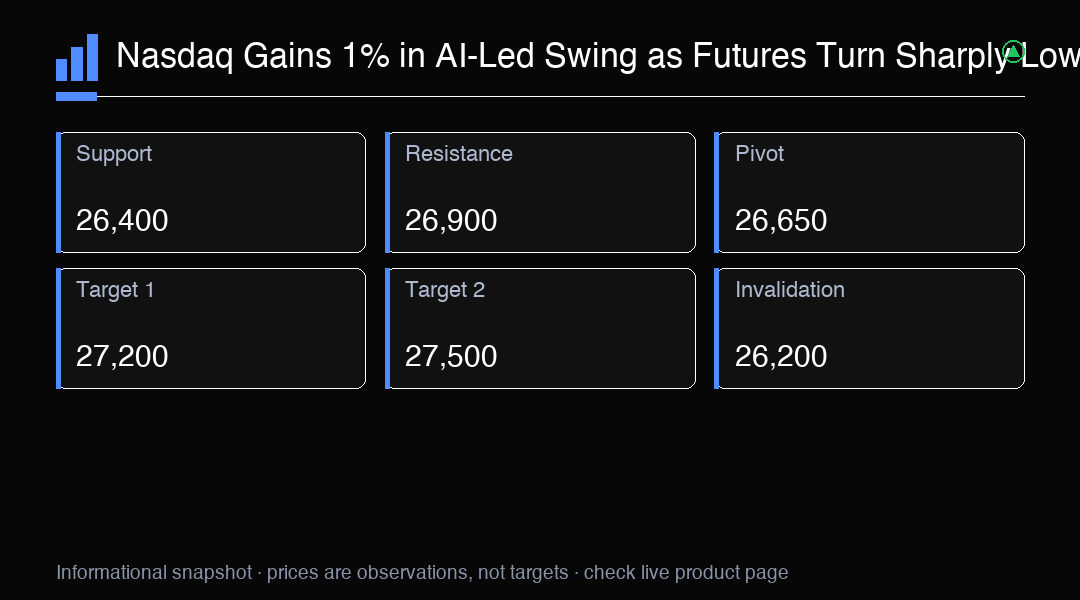
Trading Insight
The Nasdaq gained 1.05% to 26,702.86 on an AI-led rally, but futures fell 1.1% as Brent crude climbed 1.3% to $110.30. Key support at 26,400. Watch oil and the Meta/Tesla fallout.