Leaderboard & Airdrop: Your Points Determine Your Share
Daily updates, weekly settlement, anti-cheat monitoring — how leaderboard rank turns into real airdrop allocation.

Points & Returns: The higher your points, the larger the vault deposit quota you can unlock. Specific tier rules are subject to the Vault page.
Introduction
If the points program is the measurement layer, the leaderboard and airdrop is the distribution layer. Points by themselves are just a balance on a screen; what makes them meaningful is the rule that connects them to real rewards: your rank on the season's leaderboard determines what you receive.
This guide explains how the leaderboard is calculated (hourly refresh, top 100 displayed, organized by season), what the daily-and-weekly settlement cadence actually means, how airdrop allocation maps to your rank rather than to a flat pro-rata of points, and why the real-time anti-cheat monitoring layer matters for everyone — including the honest majority who will never feel its presence.
1. How the Leaderboard Works
The leaderboard is a dynamic ranking of users by current points, refreshed hourly, and the public board displays the top 100 users.
A few mechanics to internalize:
- Hourly updates. Trading and referral activity is calculated in real time, and the public leaderboard refreshes on an hourly cadence.
- Top 100 displayed publicly. The system ranks every eligible user, but the visible board shows the top 100 directly.
- Ranking is divided into seasons. Each season is its own discrete ranking period, and airdrop allocation is tied directly to your rank within that season.
- Both trading and referral points count. The leaderboard doesn't separate them; what matters is your total points.
- Real-time anti-cheat monitoring runs throughout — covered in section 4.
The leaderboard isn't a vanity feature — it's the basis for reward distribution. When a season ends, your position on the board determines what you receive.
2. Real-Time Calculation, Hourly Refresh, Weekly Final Rank
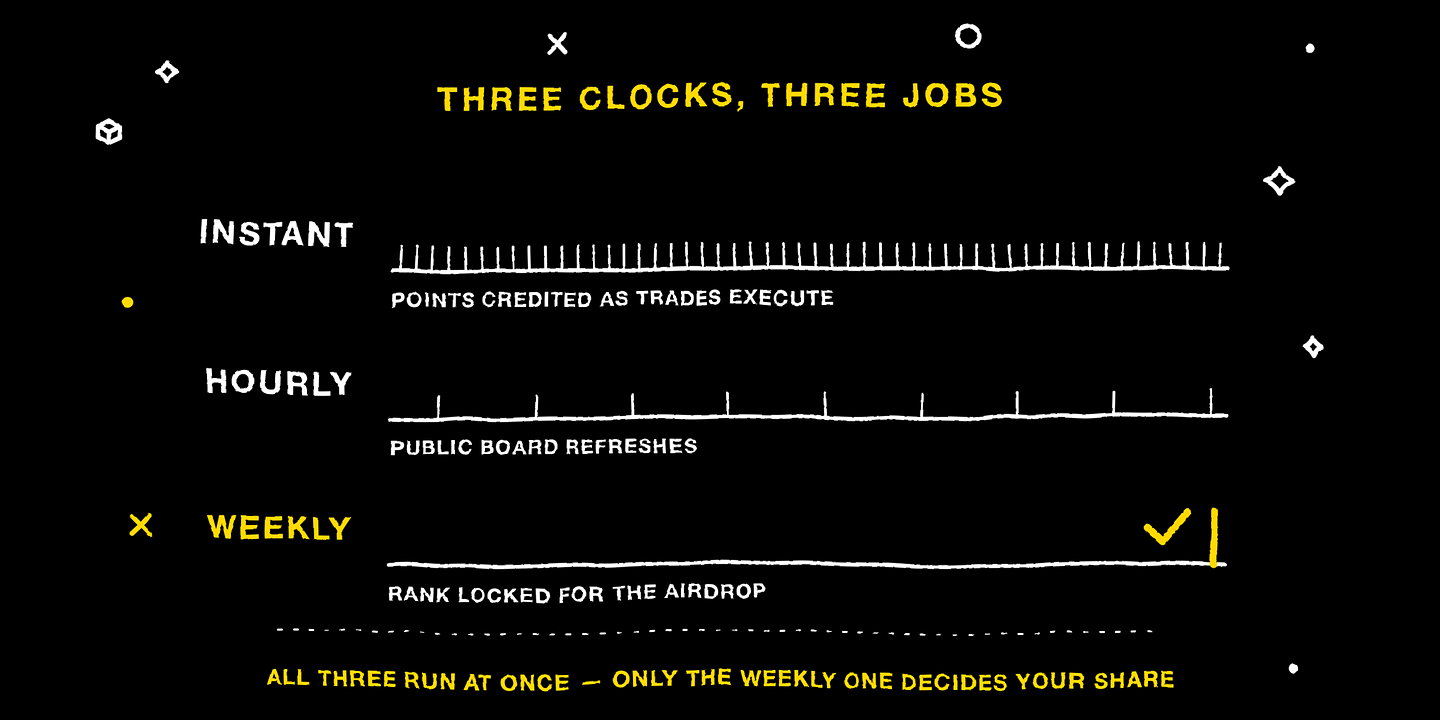
The platform uses three layers of cadence for points and ranking — understanding each layer explains every time-related question about the system:
- Real-time calculation. When a trade executes, points are auto-calculated and credited to your account in near real time. Whatever fees you pay and whatever points you earn from those fees are recorded immediately.
- Hourly leaderboard refresh. The public board updates display once per hour — that's the cadence at which you'll see your position move within the top 100.
- Daily updates / weekly final rank. Points are aggregated daily, and the weekly total determines your final rank for that season's leaderboard. Your rank at the end of the season is what airdrop allocation is based on.
Why three layers instead of one? Because each one serves a different function:
- Real-time calculation ensures every trade you make is captured immediately, with no risk of being lost or delayed.
- Hourly refresh gives everyone a current-but-stable position signal, without the noise of second-by-second flicker.
- Weekly final rank gives reward distribution a clean, defensible basis that isn't subject to last-second manipulation.
Practical implication: you don't need to watch the hourly refresh. You need to stay consistently active across the season. The moment the season ends, your aggregated points (per platform rules) determine where you land — and what you receive.
3. How Airdrop Allocation Maps to Rank
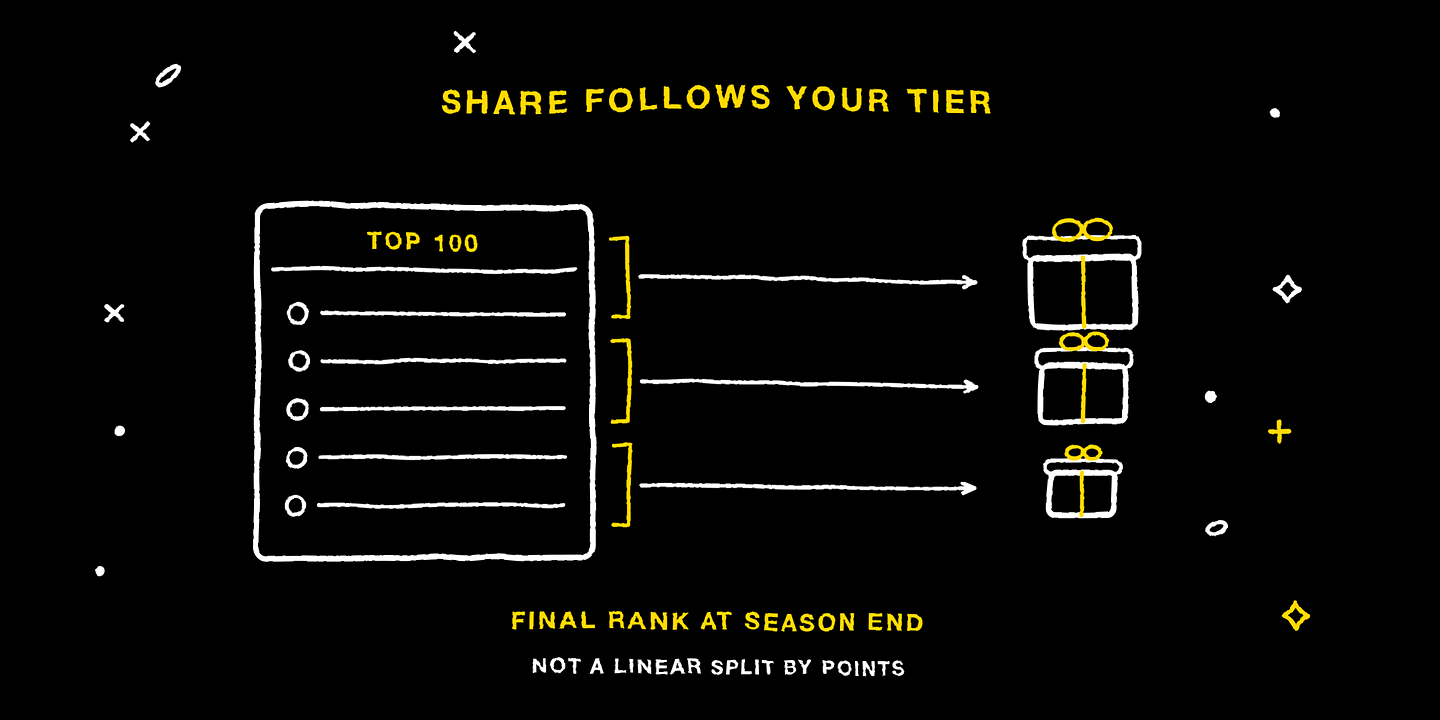
The core rule is this: airdrop allocation is tied directly to your rank tier on that season's leaderboard.
This is subtle but important — it's not what most people initially assume:
- It's not a flat "your points / total points × pool" formula. Allocation is determined by your rank tier — the higher your rank, the larger your share, with allocation stepping up as you move into higher tiers.
- Your rank at the end of the season is what counts. Your position can move up and down throughout the season, but the final rank when the season closes is what determines distribution.
- Eligibility matters. Users flagged by the anti-cheat layer (covered next) may have their rank adjusted or be excluded entirely from a given distribution.
- Each airdrop has its own specific rules. Pool size, tier structure, eligibility criteria, and the specific season(s) it applies to are all defined by the official announcement for that airdrop. Don't assume one airdrop matches another.
Practical implications:
- Crossing into the top 100 vs not is significant — appearing on the public leaderboard is itself a meaningful threshold for allocation purposes.
- Within the top 100, your specific rank still matters — the difference between rank 5 and rank 50 is typically not linear, with higher ranks receiving disproportionately larger allocations.
- Your mid-season position is mostly informational — useful for gauging whether your current pace is on track, but the season-final rank is what's locked in for distribution.
On the platform's right to adjust: the official documentation explicitly states that the team reserves the right to dynamically adjust point coefficients and decay thresholds in response to market conditions. Final parameters are governed by the latest official announcement and actual system settlement — meaning specific allocation details should always be checked against the most recent published source.
4. Anti-Cheat Monitoring: What's Being Watched
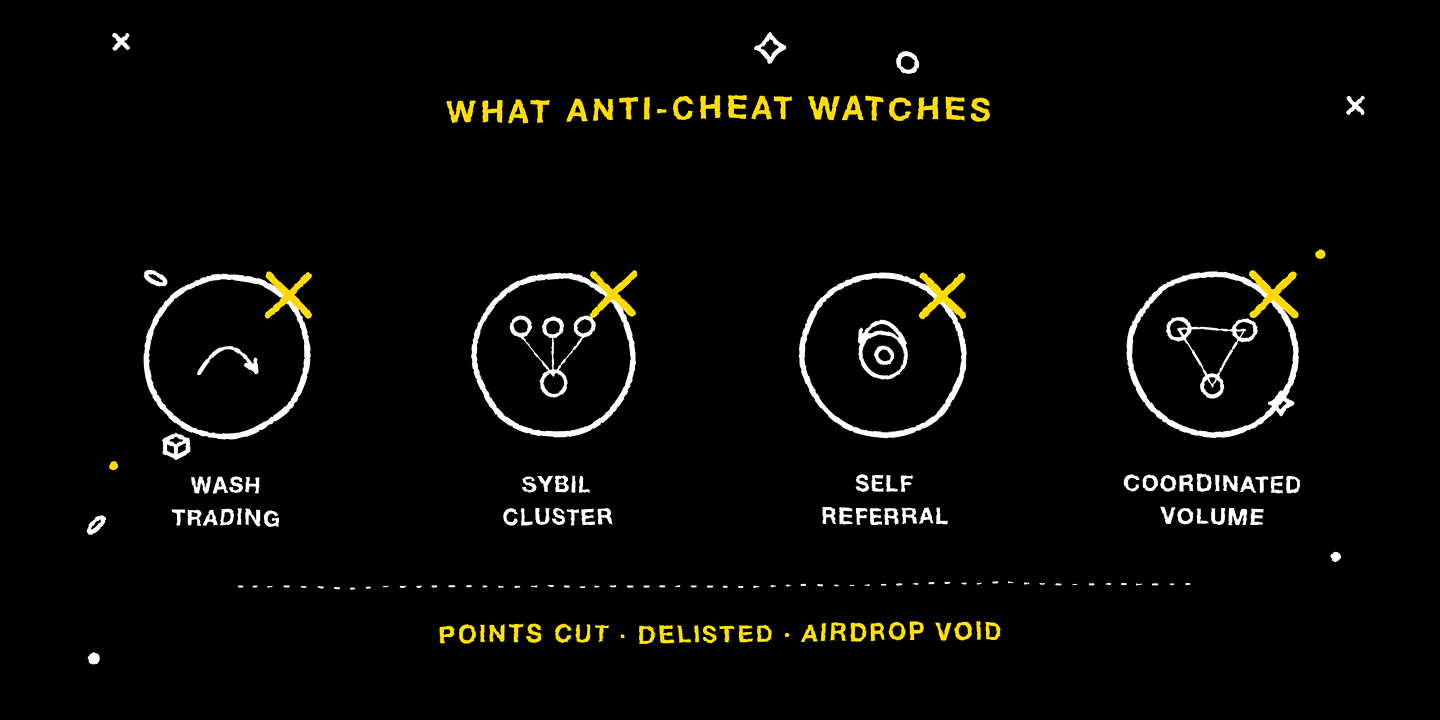
A program that distributes real rewards based on points will inevitably attract attempts to game it. The platform runs continuous monitoring to detect and prevent the most common attack patterns:
- Wash trading. Trading with yourself across multiple accounts — buying from your other account at one price, selling back at another — to manufacture trading fees and the points they generate. This is detected through pattern analysis on counterparties, timing, and price improvement vs the public order book.
- Self-referral. Creating a chain of new accounts to "refer" to your primary account, harvesting the 10% bonus on activity you would have done anyway. This is detected through device, IP, KYC, and behavioral signals.
- Sybil clusters. Coordinated networks of accounts run by the same operator, designed to multiply allocation by splitting one entity's activity across many wallets. This is detected through graph analysis of relationships between accounts.
- Collusive trading rings. Groups of users churning trades back and forth among each other to pool fee generation and maximize collective points. This is detected through network-level pattern analysis.
What happens when patterns are detected: depending on severity, consequences can include points being clawed back, exclusion from current and future airdrops, account restrictions, and (in serious cases) account closure with funds returned per platform policy.
For honest users, the monitoring layer is invisible and reassuring. It exists so that your legitimate points retain their value — they're not diluted by a thousand fake accounts farming the same allocation pool.
5. Climbing the Leaderboard, the Honest Way
A short, blunt list:
- Trade the way you'd trade anyway. Manufactured volume costs more in fees than it earns in expected airdrop value, even before anti-cheat risk.
- Understand the tiered conversion efficiency. Once your daily points output exceeds a threshold, the rate at which additional points are earned decreases. Cramming a week's volume into one day is much less efficient than distributing it evenly. Steady, consistent trading is the optimal strategy.
- Refer real users. A few high-quality referrals contribute meaningfully to your points and compound over time. Bulk referral spam doesn't.
- Stay active across the entire season. The aggregated total at season end determines your rank. Bursting hard for two weeks and then going silent typically loses to a user who's evenly active across the season.
- Read each airdrop's specific rules before adjusting behavior. Pool, tiers, eligibility, and the relevant season are all defined by that airdrop's official announcement.
Leaderboard: Updated hourly, featuring the top 100 users. Rankings are organized in season-based epochs, with airdrop allocations directly tied to your rank. Real-time anti-cheat monitoring ensures fair play.
ROI Leaderboard: Rankings are based on Return on Investment (ROI), with anti-withdrawal-gaming rules in place. The specific calculation methodology and rules are subject to the Points page.
6. Quick Recap
Dynamic Ranking System: Points are updated daily, and the final weekly point total determines each user's position on the leaderboard. Airdrop allocation ratios are directly tied to ranking tiers, and real-time anti-cheating monitoring is in place to ensure a fair and healthy ecosystem for all participants.
The four ideas worth keeping:
- The leaderboard refreshes hourly and publicly displays the top 100, organized by season. Points are calculated in real time, aggregated daily, and the weekly total determines your rank.
- Airdrop allocation is tied to your rank tier at season end — not a flat pro-rata of points. Top-100 vs not is a significant threshold; within the top 100, higher ranks receive disproportionately larger shares.
- Each airdrop has its own specific rules — pool, tiers, and eligibility are defined by the official announcement. The platform also reserves the right to adjust coefficients and thresholds; final parameters are always governed by the latest official source.
- Real-time anti-cheat monitoring runs throughout — wash trading, self-referrals, sybils, and collusion are detected and penalized. The monitoring layer exists to protect honest users' reward value, not to penalize legitimate activity.
Risk Disclosure
Airdrop rules, leaderboard mechanics, and anti-cheat policies described here reflect current platform parameters and may be updated; always check the specific airdrop announcement and official documentation for current details. Points and any associated rewards are not guaranteed financial returns. Trade based on your own analysis and risk tolerance, with capital you can afford to lose.
No more