Complete Spot Trading Guide: 0.05% Fee
Buy BTC, ETH, and SOL with USDC — what spot trading is, what 0.05% really costs, and how to make your first trade.

Introduction
Spot trading is the simplest way to participate in the crypto market — and for most people, it's also the right place to start. There's no leverage to manage, no funding rates to monitor, no liquidation engine watching over your position. You buy an asset, you own that asset, and your worst-case outcome is the asset going to zero.
This guide walks through everything you need to make your first spot trade with confidence: what spot trading really is, why USDC is the pairing currency, how the 0.05% fee translates into real dollars, and how a buy or sell unfolds step by step. By the end, you'll be able to convert USDC into BTC, ETH, or SOL — and back — without guesswork.
1. What "Spot Trading" Means
In spot trading, you exchange one asset for another at the current market price, immediately, with full ownership transferring to you on the spot — hence the name.
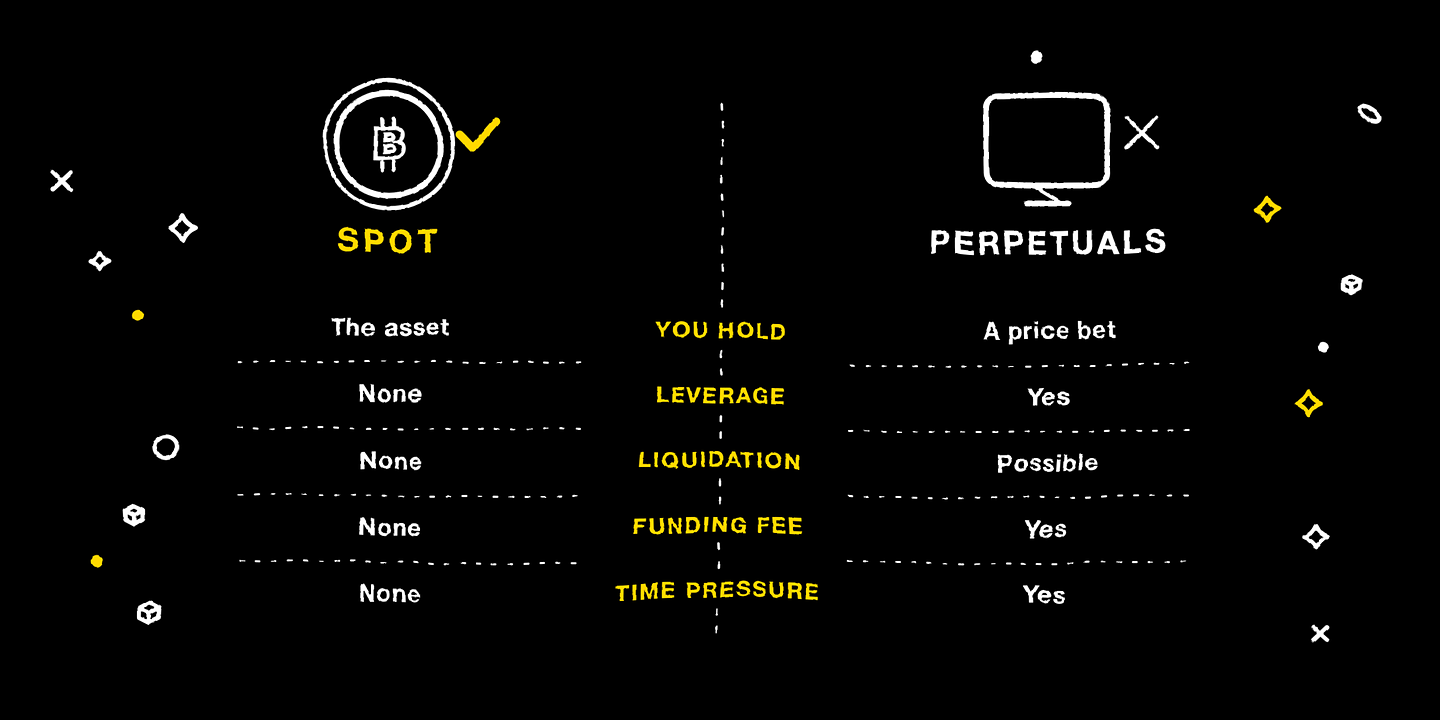
If you spend 1,000 USDC to buy BTC, you now own that BTC. It sits in your account. You can hold it for ten minutes or ten years. You can withdraw it to a wallet you control. You don't owe anyone collateral, and no one can liquidate you.
Compare that to a perpetual contract, where you take a leveraged position on BTC's price without ever owning BTC and where margin and liquidation rules apply throughout. Same direction (long BTC), very different mechanics. (See the Perpetual Contracts guide if you want the contrast in detail.)
Two practical rules of thumb:
- If your goal is long-term holding of BTC, ETH, or SOL — buy spot.
- If your goal is short-term directional speculation with leverage — perpetuals are designed for that.
Most healthy crypto portfolios are a mix: spot for the core position, perpetuals for tactical trades around it.
2. Why USDC Is the Pairing Currency
Most spot pairs on this platform quote against USDC (USD Coin), a stablecoin pegged 1:1 to the US dollar and backed by reserves attested to monthly. There are several reasons USDC was chosen over alternatives:
- Regulatory clarity. USDC is issued by Circle, a US-regulated company that publishes reserve attestations. For most users, that translates to lower counterparty risk than less-transparent stablecoins.
- Deep liquidity across venues. USDC trades in size on most major exchanges and DeFi protocols, so what you buy here behaves the same way you'd expect it to elsewhere.
- Simple mental math. Because 1 USDC ≈ 1 USD, every quoted price reads naturally in dollars. No mental conversion required.
USDC vs USDT: both are dollar-pegged stablecoins, but they're issued by different companies (Circle for USDC, Tether for USDT) with different reserve and disclosure practices. For the trading you'll do here, the user-facing experience is essentially identical; the choice of USDC reflects the platform's preference for the more transparent option.
3. Reading a Spot Pair
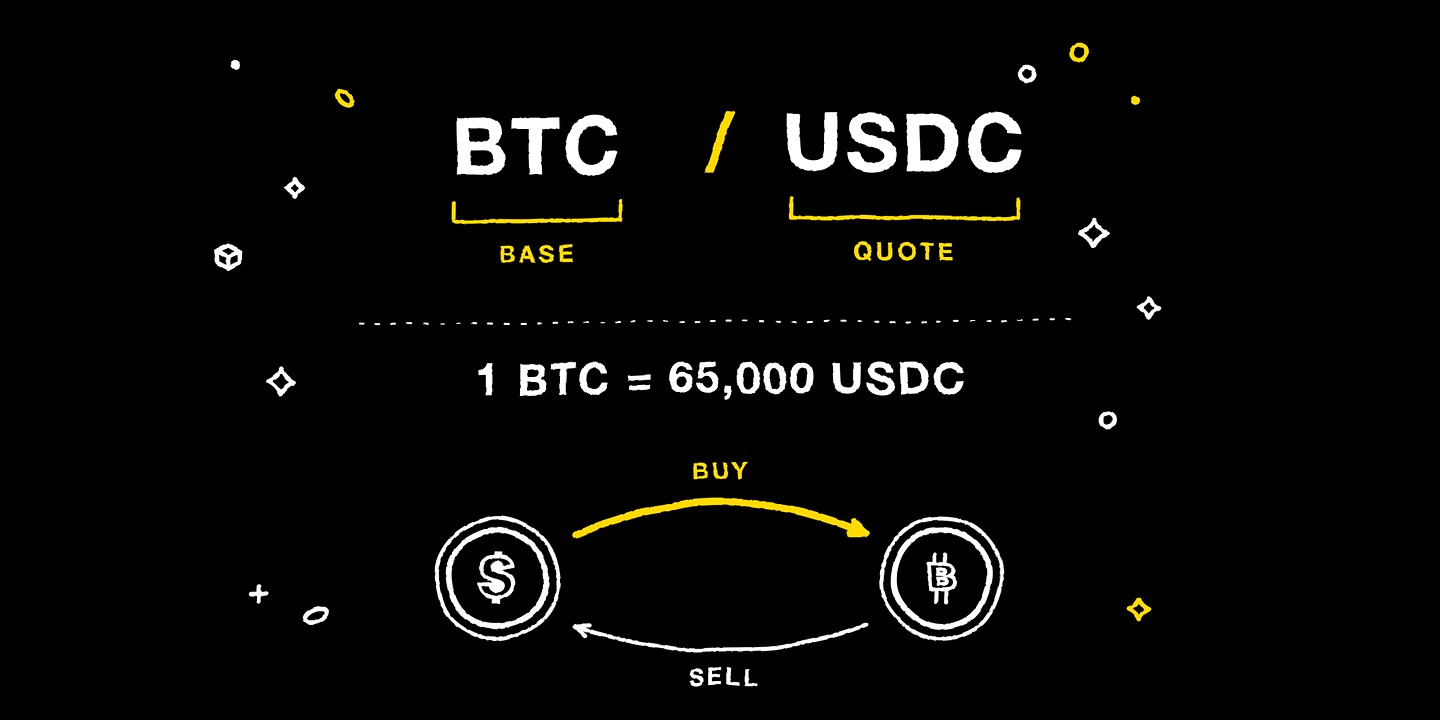
A spot pair is written as BASE / QUOTE — the base is what you're buying, the quote is what you're spending.
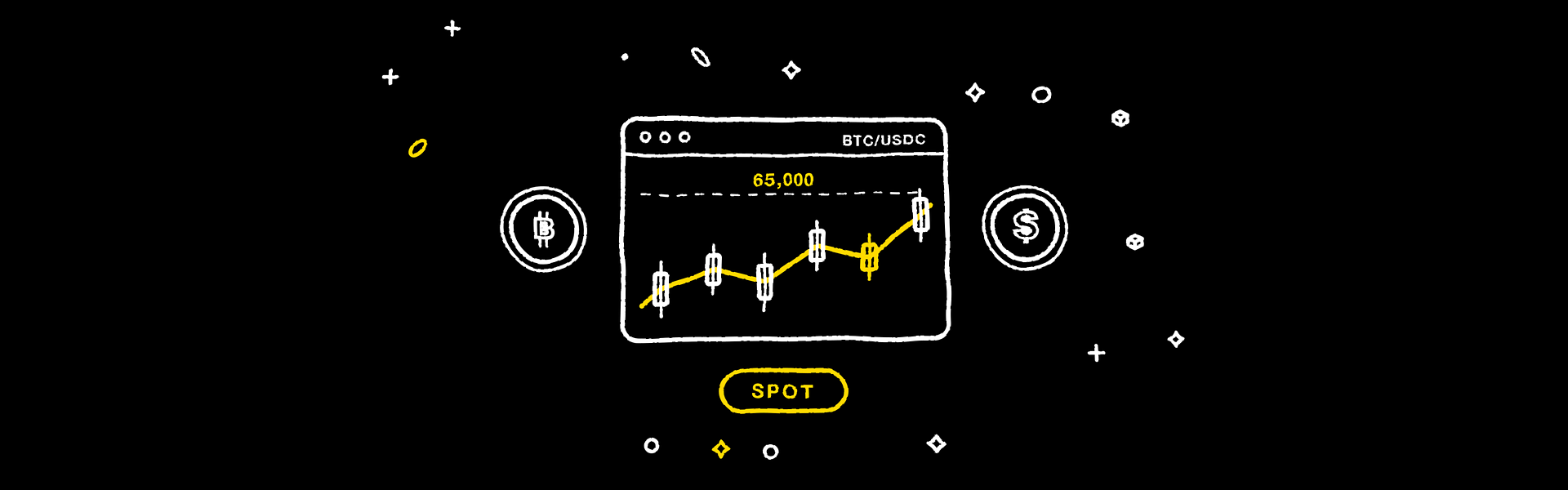
- BTC/USDC at $65,000 means: 1 BTC costs 65,000 USDC.
- ETH/USDC at $3,200 means: 1 ETH costs 3,200 USDC.
- SOL/USDC at $150 means: 1 SOL costs 150 USDC.
When you "buy BTC/USDC," you're spending USDC to receive BTC. When you "sell BTC/USDC," you're sending BTC to receive USDC. Same pair, opposite direction.
This convention is universal across exchanges, so the habit transfers anywhere you trade.
4. The 0.05% Fee, in Real Dollars
The platform charges a flat 0.05% fee per spot trade — once when you buy, once when you sell.
Worked example:
- You buy 1,000 USDC of BTC. Fee = 1,000 × 0.05% = $0.50. You receive BTC worth roughly $999.50.
- Later, you sell that BTC for 1,200 USDC. Fee = 1,200 × 0.05% = $0.60. You receive $1,199.40.
- Round-trip cost: $1.10 on a trade that earned you $200. Effectively, fees consumed about 0.55% of your gross profit.
A few things to internalize:
- The fee is on the dollar value of the trade, not on your profit.
- Both buying and selling are charged. Round-trip cost ≈ 0.10% of the position size.
- 0.05% is competitive — many global brokers charge several times this on equivalent products. (See the Fee Overview guide for the full schedule across spot, gold, and forex.)
What's not charged on spot trades: there's no funding rate, no overnight interest, no hidden carry. Once you've paid the trading fee, the only thing affecting your position's value is the market price of the asset.
5. Making Your First Spot Trade, Step by Step
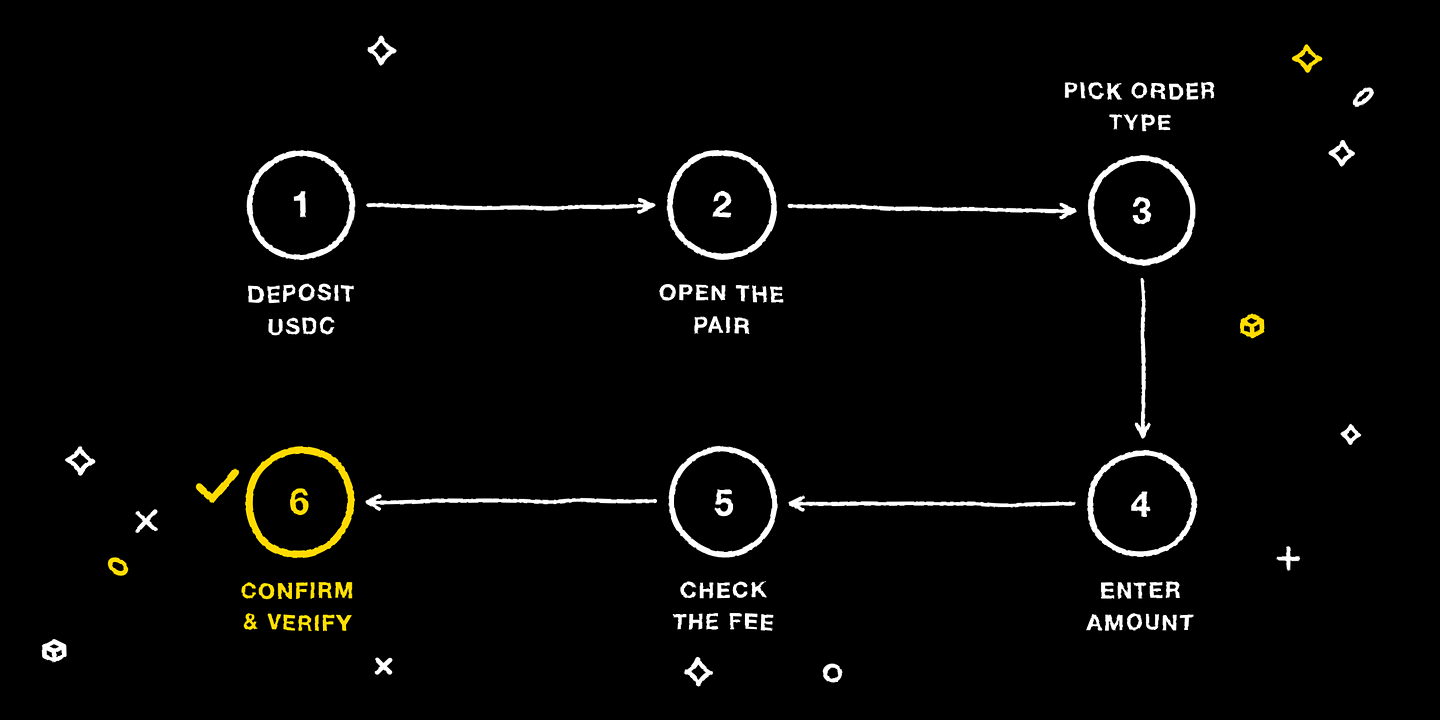
A complete first purchase, top to bottom:
- Fund your account with USDC. This typically means depositing USDC from another exchange or wallet onto the platform. Always double-check the network (Ethereum, Solana, Polygon, etc.) — sending on the wrong network is the most common way deposits get lost.
- Open the trading page for your chosen pair. Pick BTC/USDC, ETH/USDC, or SOL/USDC depending on what you want to buy.
- Choose order type. Market order for "buy at the current price right now"; limit order if you want to set a specific price and wait for the market to come to you. (See the Order Types guide if you want to choose between them deliberately.)
- Enter the amount. Spot orders can usually be entered as either how much USDC you want to spend or how much BTC you want to receive — both arrive at the same place. Pick whichever feels more natural.
- Review fees and final amount. The order ticket should show the estimated quantity received and the 0.05% fee before you confirm. Verify before clicking.
- Confirm. A market order fills almost instantly. A limit order will sit on the order book until the market hits your price.
- Check your balance. Your USDC balance has gone down; your BTC balance has gone up. That asset is now yours, full stop.
If at any step the displayed numbers don't match what you expected, don't confirm. Pause, recheck the pair, the amount, and the network. Most "I lost money" stories on spot start with a clicked confirmation that should have been a pause.
6. Where Your Assets Actually Live
After your trade fills, the BTC (or ETH, or SOL) you bought sits in your platform account. Two practical implications:
- You can trade or sell it instantly — it's already on the exchange, ready to go.
- You can withdraw it to a wallet you control if you prefer self-custody, especially for long-term holds. The withdrawal will incur a network fee that depends on the asset and the network, not the platform's flat 0.05% trading fee.
For active traders who buy and sell frequently, keeping assets on the platform is the simpler workflow. For long-term holders ("buy and hold for years"), withdrawing to a personal wallet is a common practice — accept the small friction in exchange for full control of your private keys.
There's no single right answer; the choice depends on your strategy, your security setup, and how often you intend to trade.
7. Common Beginner Mistakes
Five patterns that account for most early frustration:
- Sending a deposit on the wrong network. USDC exists on Ethereum, Solana, Polygon, Arbitrum, and others — they're not interchangeable. Always confirm the network on both ends of the transfer.
- Confusing the price with the amount. Entering "65,000" thinking you'll spend $65,000 when the field actually wants quantity in BTC (= $4 billion at $65k/BTC) is a mistake the order ticket usually catches, but not always. Read the labels.
- Buying the entire balance, leaving none for the fee. On most platforms the fee is deducted from the asset you receive, but on some you need a small USDC buffer. Leave a few dollars of headroom on your first trade.
- Treating spot like leverage. A 5% drop on a 1 BTC spot position is a 5% loss. A 5% drop on a 5x perpetual position is a 25% loss. They're not the same thing.
- Selling at the first dip. Spot's main advantage — no liquidation, no time pressure — only works if you don't manufacture pressure for yourself. Decide your holding period before you buy, not during the first red candle after.
In MC Markets, spot refers to buying digital assets (such as BTC, ETH, SOL, etc) directly using USDC in your account, or selling these assets to receive USDC back. All spot pairs carry a 0.05% fee.
Do I need KYC to trade crypto? No. Cryptocurrency spot and perpetual trading is available without KYC. However, trading RWA instruments such as forex, gold, indices, and other traditional assets requires at least L0 verification.
8. Quick Recap
The four ideas worth taking with you:
- Spot trading is exchanging one asset for another at the current market price, with full ownership transferring immediately. No leverage, no liquidation, no funding.
- USDC is the pairing currency because of its regulatory transparency, deep liquidity, and 1:1 dollar peg. Pairs are quoted as BASE/USDC — buy BTC/USDC means spending USDC to receive BTC.
- The 0.05% fee is charged once on buy and once on sell, calculated on the dollar value of the trade. Round-trip cost on a position is approximately 0.10%.
- Funding the account, choosing the order type, entering the amount, and confirming is the entire workflow. Pause and verify whenever the numbers don't match what you expected.
Risk Disclosure
Cryptocurrency prices are highly volatile and can result in substantial losses. Spot trading carries less structural risk than leveraged products, but the underlying assets themselves can lose significant value. Past performance does not guarantee future results. Trade only with capital you can afford to lose, and consult a qualified financial advisor if you are unsure whether crypto assets are appropriate for your situation.
No more