


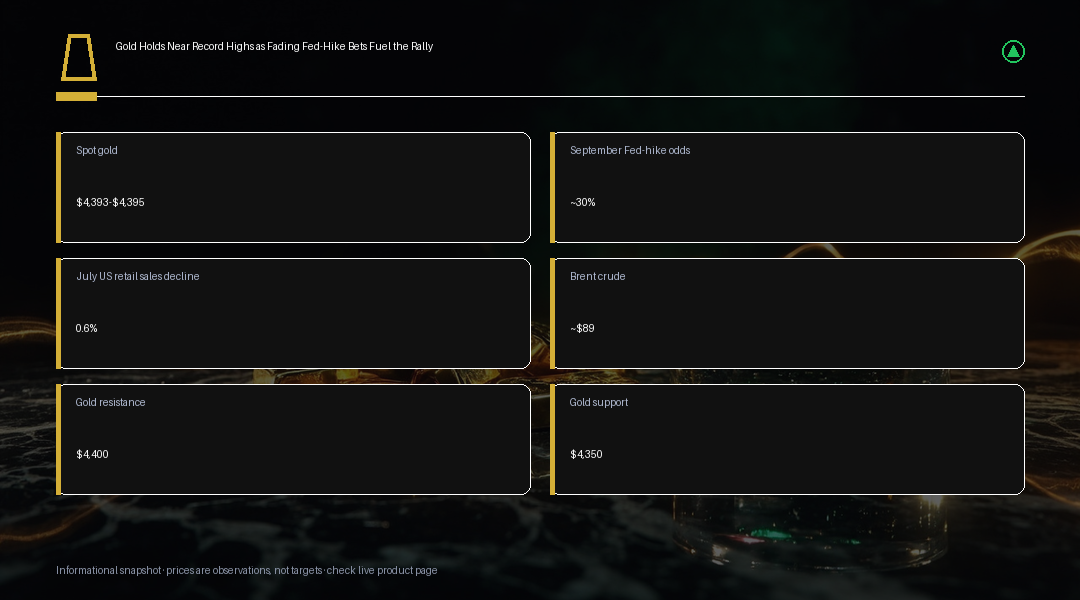
Gold has extended its August rally, with spot prices trading in the $4,393 to $4,395 area, with an intraday high near $4,416 an ounce over the past week as a softer US dollar and cooling growth data revive demand for the metal. The move higher builds on a run that has already taken bullion to some of its strongest levels of the year, and it comes as traders increasingly bet that the Federal Reserve's tightening cycle is effectively over for now, a backdrop that historically supports an asset that pays no yield of its own.
The rate story is doing most of the heavy lifting. July employment data disappointed, consumer price inflation eased to 3.4% year over year from 3.5%, and retail sales unexpectedly fell 0.6% for the month, the first monthly decline in nine months. Producer prices told a more mixed story, holding flat on the month but still running at an elevated 4.7% annual pace, a reminder that the disinflation story is not uniform across every part of the economy even as the overall direction has been favorable for gold. Taken together, the data has pushed market pricing for a September Fed rate increase down to roughly 30%, and lower expected interest rates reduce the opportunity cost of holding a non-yielding asset like gold. Core CPI eased to 2.5% year over year from 2.6%, reinforcing the broader disinflation narrative even as the producer-price detail argues for some caution about declaring the fight against inflation fully won.
The Federal Reserve's own calendar adds a nuance worth watching. The central bank held its policy rate steady at its July 28-29 meeting, and minutes from that gathering are due for release this week. Because the meeting itself predates the recent run of soft employment, inflation and retail-sales data, the minutes will show how divided officials were at the time rather than how they view the newest numbers, and traders should be cautious about reading too much forward-looking signal into a backward-looking document.
Oil markets are complicating what would otherwise be a straightforward bullish setup for gold. Brent crude has been trading near $89 a barrel, close to the closely watched $90 threshold, as talks between the United States and Iran remain stalled and tanker traffic through the Strait of Hormuz has slowed sharply following recent attacks. Geopolitical tension of this kind typically supports gold's traditional safe-haven appeal, but sustained higher energy prices can also revive inflation pressure and force central banks to stay tighter for longer, creating a genuine tension between two forces pulling on the metal from different directions.
That tension defines the bull case for gold heading into the rest of the month. The rally needs continued anxiety over oil-driven geopolitical risk without a full-blown inflationary relapse that would force the Federal Reserve to reconsider its more dovish recent tone. An escalation in attacks or infrastructure damage around the Strait of Hormuz could initially drive further safe-haven buying in gold, but a sustained move in crude above $90 a barrel risks lifting bond yields and pressuring bullion from the other direction, particularly if it feeds into fresh concern about a stalled disinflation trend.
This week's broader US data calendar adds further texture to the setup. Reports on housing, industrial production and business activity are due alongside the UK's own inflation release, and each carries the potential to move global bond yields and the dollar in ways that spill over into gold pricing. None of these releases individually rivals the importance of the Fed minutes or the underlying rate story, but collectively they add to the list of catalysts that could nudge gold decisively out of its current range in either direction. Silver, platinum and palladium have also been firm in recent sessions, and a broad-based move across the precious-metals complex, rather than gold moving in isolation, would tend to support the idea that the rally reflects a genuine shift in the rate and dollar outlook rather than a narrow, single-asset trade.
From a technical standpoint, MC Markets' desk treats the area just above $4,400 as an important psychological level for gold, with a further region between roughly $4,440 and $4,450 marking the next resistance zone on a sustained breakout. On the downside, support sits near $4,350, with a deeper floor around $4,300 should sentiment turn. It is worth noting that spot prices have already traded above the $4,400 area intraday during the past week, so a confirmed close above that zone, rather than a brief intraday probe, would be the more meaningful signal that the current rally has genuine follow-through. Momentum indicators on the daily chart remain constructive as long as gold holds above the $4,350 support area, giving trend-following strategies a relatively clear invalidation point to work with.
Put together, gold's setup into the back half of August rests on a fragile but currently favorable combination: fading Fed-hike expectations, a softer dollar, and geopolitical risk in the oil market that has so far supported rather than undermined the metal's safe-haven appeal. A sustained break above resistance would extend the current rally, while a rejection at these levels would leave gold consolidating within its recent range as traders wait for clearer signals from this week's Fed minutes and the broader run of US economic data.
Trading Insight
For traders, the interplay between fading Fed-hike expectations and a volatile oil market makes gold's next move highly data-dependent this week. A confirmed close above the $4,400 area, rather than the brief intraday moves already seen this month, would be the more meaningful signal that the rally has genuine follow-through toward the $4,440 to $4,450 zone. A rejection at current levels, particularly if this week's Fed minutes read more hawkish than the market currently expects or if oil prices ease back from the $89 area, would leave gold vulnerable to a pullback toward $4,350 and potentially $4,300. Because the Fed minutes cover a meeting that predates the recent run of soft US data, any hawkish-sounding language in them should be weighed against the more dovish tone of what has actually been reported since that meeting. The oil market is the other variable to watch closely: continued anxiety over Hormuz tanker traffic without a full inflationary relapse would support gold's safe-haven bid, while a sustained move in Brent crude above $90 a barrel could lift bond yields enough to pressure bullion even amid otherwise favorable rate expectations. This week's housing, industrial-production and business-activity data add further inputs that could tip the balance in either direction before the month is out.