


The dollar is testing familiar territory against the yen again. Less than three weeks after Tokyo and Washington carried out their first joint currency intervention since 1998, USD/JPY has climbed back to roughly 159, within striking distance of the 160 level that triggered the rescue in the first place. The round trip is a reminder that intervention can interrupt a trend, but it rarely reverses one on its own.
The late July intervention was large by any standard. That bounce cost authorities tens of billions of dollars, with Japan doing most of the heavy lifting and the US Treasury adding its own dollar-selling support. Together, the two sides pushed USD/JPY from around 163 to 164 down to about 155 in a matter of days. That kind of firepower can flush out leveraged positioning and create sharp, headline grabbing moves, but it cannot permanently offset the interest rate gap between the US and Japan, nor can it erase Japan's fiscal concerns.
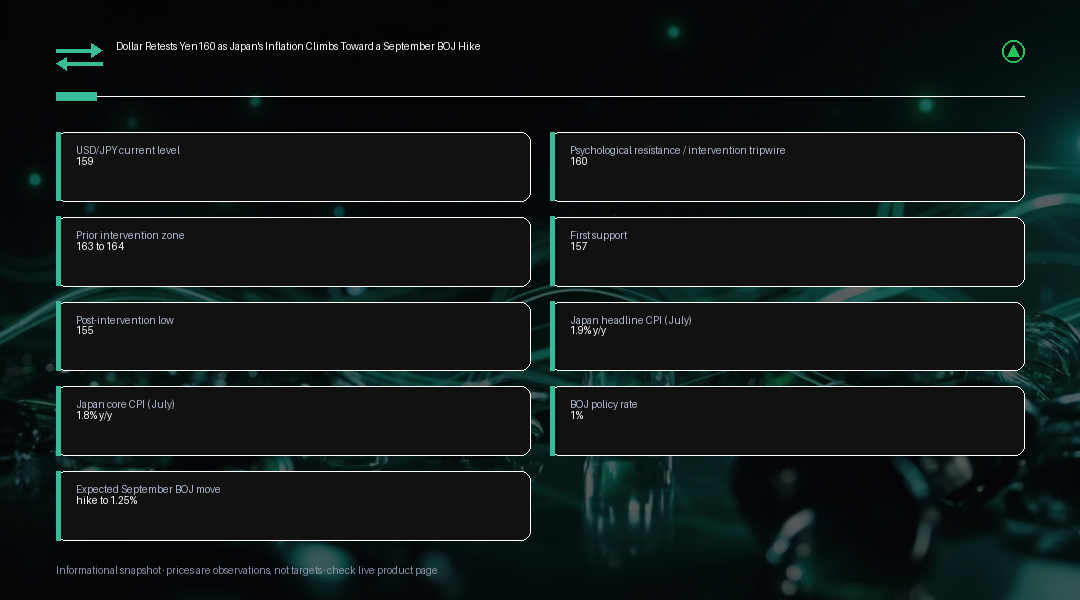
Inflation data released Friday gave the Bank of Japan fresh cover to keep tightening. Headline consumer prices rose 1.9% year over year in July, up from 1.6% in June and the highest reading since December 2025. Core inflation, which excludes fresh food, accelerated to 1.8% from 1.6%. A narrower measure that also strips out energy costs, often called core core inflation, climbed to 1.9%, its fastest increase in three months. None of the readings are dramatic in isolation, but together they build a case for policymakers who have already shown a willingness to move.
The BOJ left its policy rate unchanged at 1% at its July 30 to 31 meeting, but the vote was not unanimous. One board member pushed for an immediate move to 1.25%, and economists increasingly expect the rest of the board to catch up at the September meeting. A quarter point hike would narrow, though not eliminate, the yield gap that has kept the yen structurally weak. Traders have heard versions of this story before. BOJ normalization has been described as coming soon for years, usually while the dollar yen pair kept climbing anyway, so the market's skepticism is earned rather than reflexive.
The broader dollar backdrop is more mixed than a simple weakness narrative suggests. The US Treasury's August 19 announcement that it would double the size of its long dated bond buybacks, to at least $4 billion per operation, initially pushed yields lower and weighed on the dollar. That relief did not last. By August 20, Treasury yields had climbed back toward multi-decade highs, as investors questioned whether limited buybacks can meaningfully offset America's mounting federal debt. The dollar recovered alongside those yields, which is part of why USD/JPY has drifted back up toward 159 even without a fresh domestic catalyst.
Technically, 160 is doing double duty as both a psychological level and an intervention tripwire. A clean, sustained break above it would tell the market that traders are no longer as worried about a second rescue operation as they were three weeks ago, and it could open the door back toward the 163 to 164 zone where the last intervention began. On the way down, 157 is the first meaningful support, with the post intervention low near 155 as the deeper floor. Some strategists continue to peg the yen's medium term fair value closer to 165 to 167 based on rate differentials alone, which helps explain why every rally toward 160 draws so much attention.
Context also matters for why this particular Friday's data landed the way it did. Japan's statistics bureau publishes its consumer price index monthly, and the July report was the first full month of data following the intervention, giving markets a chance to judge whether the currency shock had any secondary effects on prices. Officials will be watching for pass through from a weaker yen into import costs, particularly energy and food, in the months ahead, since a currency that cheapens imports can itself add to the inflation picture the BOJ is trying to manage.
The interplay between Japanese and US policy is unusually tight right now. If the Federal Reserve holds rates steady in September, which futures markets currently assign roughly two thirds odds of happening, and the BOJ delivers its expected quarter point hike in the same month, the yield gap would narrow modestly, a combination that has historically supported the yen. If either side surprises the other, in either direction, USD/JPY could move quickly given how tightly positioned the pair has become around the 160 line.
For now, the tug of war looks set to continue. Japan has an inflation problem that argues for higher rates and a stronger currency. The US has a fiscal and yield problem that keeps pulling capital toward dollar assets despite the Federal Reserve's own rate cut debate. Verbal warnings from Japanese officials can still produce sharp, short lived moves, but a durable shift in the yen probably requires the BOJ to actually deliver a hike rather than simply signal one.
Trading Insight
For traders, 160 is the single most important number on the chart right now. A confirmed close above it, especially on rising volume, would suggest the market is losing its fear of a second joint intervention and could open a path back toward 163 to 164. A rejection at or below 160, on the other hand, keeps the pair inside its recent range and puts 157 and then 155 back in focus as downside levels to watch. Because verbal intervention alone has repeatedly produced sharp intraday reversals without changing the medium term trend, MC Markets clients trading USD/JPY may want to size positions with that volatility in mind rather than assuming any single headline resolves the standoff. The September Bank of Japan meeting is the next real catalyst: a confirmed hike to 1.25% would be the first concrete step toward closing the rate gap that has kept the yen persistently weak, while another hold would likely reinforce the market's current skepticism toward BOJ normalization.