


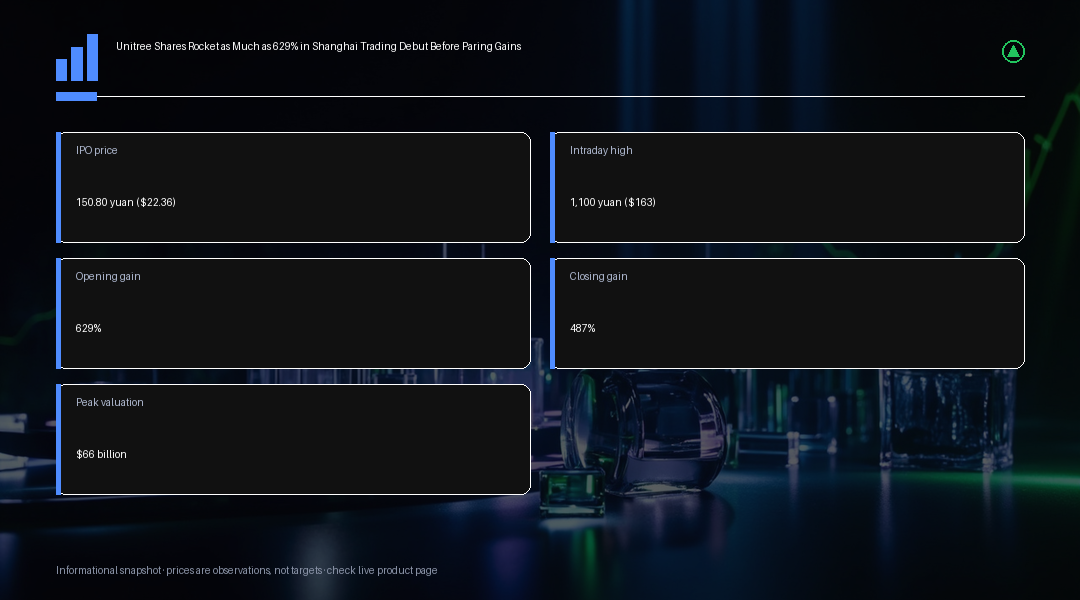
Unitree Robotics, mainland China's first listed pure play humanoid robot maker, staged one of the most dramatic stock market debuts of the year on Wednesday. Shares in the Hangzhou based company, formally registered as Yushu Technology, opened for trading on the Shanghai STAR Market and surged as much as 629% intraday, rocketing from an IPO price of 150.80 yuan, about $22.36, to a session high of 1,100 yuan, about $163. That intraday spike briefly pushed Unitree's market value to roughly $66 billion, more than seven times the approximately $9 billion valuation set at its initial public offering. By the close, shares had settled lower but still finished the day up 487%, leaving the company with a market capitalization of roughly $53 billion.
The debut capped an IPO that raised 6.1 billion yuan, about $904 million, through the sale of roughly 40.4 million shares, equal to about 10% of Unitree's enlarged share capital. Retail investor demand for the offering exceeded the available allocation by more than 5,000 times, according to underwriting data, with some estimates of the oversubscription ratio running as high as 8,000 times depending on how the tranches are counted. The overwhelming demand relative to a deliberately small initial float helped amplify Wednesday's price swings in both directions.
The rally also delivered an extraordinary paper windfall for founder Wang Xingxing, who started the company in 2016 building robotic dogs before pivoting to humanoid machines. Wang holds roughly 20% to 21% of Unitree directly following the listing, a stake that was worth more than $12 billion at Wednesday's intraday peak valuation, though that figure moves with the stock and should be read as a snapshot rather than realized wealth. Unitree's investor roster includes Tencent, Alibaba, DeepSeek, and several state backed funds, including China's National Social Security Fund, underscoring the strategic importance Beijing has placed on the listing as part of its push into what officials call embodied AI, artificial intelligence that operates through physical machines rather than software alone.
Unlike many early stage robotics companies, Unitree is already generating revenue and profit. The company shipped more than 5,500 humanoid and quadruped robots in 2025, generating roughly 1.70 billion yuan in revenue and a net profit of about 278 million yuan on a GAAP basis, or roughly 591 million yuan on an adjusted basis excluding one time items. Humanoid robots accounted for slightly more than half of that core business. China produced an estimated 82% to 85% of the world's humanoid robot shipments in 2025, a concentration that has continued to build through the first half of 2026 and gives Beijing's embodied AI ambitions genuine industrial weight behind the market enthusiasm.
That enthusiasm has pushed Unitree's valuation into territory that leaves little room for error. At its opening trade, the stock changed hands at roughly 1,200 times trailing earnings, a multiple that climbed to nearly 1,300 times by the close. A price to earnings ratio at that level implies investors are pricing in not just strong growth but years of near flawless execution, well beyond what almost any industrial company has historically delivered. Commercialization remains the central question. While Unitree's machines can run, dance, and perform acrobatic routines that circulate widely online, many customers are still primarily using them for demonstrations, research, and AI training data rather than large scale deployment as a substitute for human labor. Unit prices in the hundreds of thousands of yuan mean the economics of replacing workers with robots at scale are not yet proven.
The size of Wednesday's swing also says something about market structure rather than only sentiment. With such a small share of Unitree's enlarged capital in public hands, even modest shifts in buying or selling pressure can move the price by an outsized amount, a dynamic common to newly listed, tightly floated shares on the STAR Market. Investors weighing exposure to the stock, directly or through the broader China embodied AI theme, should treat Wednesday's peak valuation as a fleeting extreme rather than a settled market view of the company's worth.
Unitree's debut adds to a string of blockbuster first day pops on the STAR Market, Shanghai's Nasdaq style board for technology listings, which has historically featured small initial floats and strict short selling restrictions that can exaggerate early price swings in both directions. Regulators have periodically tightened rules around day one trading limits following past episodes of extreme volatility, though Wednesday's move shows those safeguards still leave enormous room for triple digit percentage swings when retail demand this heavily outstrips available supply.
The listing also arrives against a backdrop of rising geopolitical scrutiny of Chinese robotics exporters. Reports covering the first half of 2026 highlighted tightening restrictions in some Western markets on imports of Chinese made humanoid and quadruped robots, citing national security and data concerns, a risk factor that could complicate Unitree's ambitions to expand sales beyond China even as its domestic order book grows. Investors weighing the stock's premium valuation will need to monitor both the pace of policy actions abroad and how quickly Unitree can convert its dominant position in a fast growing, Beijing backed industry into durable, repeatable revenue rather than one off demonstration orders.
Trading Insight
For traders, Wednesday's action is a textbook example of price discovery breaking down around a tightly floated IPO. With only about 10% of Unitree's enlarged share capital in public hands and retail demand exceeding supply by thousands of times, the stock's early moves said more about scarcity than a considered view of long term value. The intraday round trip from a $9 billion IPO valuation to a $66 billion peak and back to a $53 billion close illustrates how violently thinly floated, high profile listings can swing once trading opens. As lockup periods expire and additional shares become available over coming months, supply is likely to increase against what may be cooling retail enthusiasm, a combination that has historically produced sharp reversals in similarly structured debuts. Traders without direct access to 688836 can track the broader AI and robotics investment theme, which remains closely linked to sentiment across Nasdaq listed AI infrastructure and technology names.