


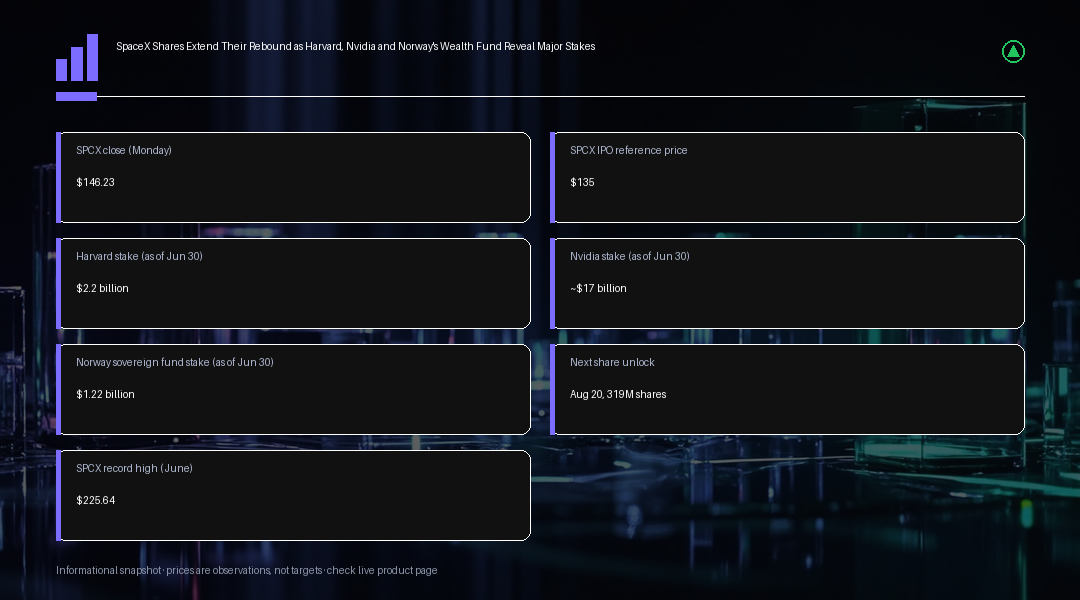
SpaceX shares traded under the ticker SPCX jumped 4.5% Monday to $146.23, extending a recovery that has now carried the stock well above its $135 initial listing price. The move came alongside a fresh round of regulatory disclosures showing that some of the world's largest institutional investors, university endowments and a sovereign wealth fund have been building substantial positions in the company, even as a wave of previously restricted shares steadily approaches the point where they can be freely traded.
Harvard's endowment disclosed a position of just under 13 million Class A shares worth more than $2.2 billion as of June 30, making SpaceX its largest reported single US equity holding. Italy's Intesa Sanpaolo reported a stake of roughly $966 million, while Fidelity, BlackRock, Baillie Gifford and Ontario Teachers' Pension Plan collectively disclosed holdings running into the hundreds of millions of dollars. It is worth stressing that these figures are drawn from mid-year regulatory filings dated June 30 and reflect a snapshot in time rather than a live, continuously updated ownership picture; any of these institutions could have trimmed or added to their positions since that date.
Norway's sovereign wealth fund, the roughly $2.3 trillion pool that stands as the largest of its kind in the world, reported a 0.05% stake in SpaceX worth approximately $1.22 billion, also as of June 30. The disclosure marks one of the fund's more notable forays into a private aerospace and satellite-communications business, and underscores how mainstream SpaceX's investor base has become even before any conventional public listing of its core operating entity.
Among the technology names with a stake in the business, Alphabet's roughly 551 million shares were recently valued near $77 billion, while Nvidia's position of approximately 123 million shares was valued around $17 billion as of the same June 30 reporting date. Nvidia's exposure traces back to its earlier investment in Elon Musk's xAI venture, which was folded into SpaceX after Musk merged the two businesses. Peter Thiel's Founders Fund holds an estimated 427 million shares, while longtime Musk ally Antonio Gracias holds more than 500 million. Musk himself remains comfortably the largest shareholder, with roughly 6.4 billion shares, or about 48% of the company, that stay locked until June 2027.
The scale of institutional interest reflects the breadth of SpaceX's business, which now spans reusable launch vehicles, the Starlink satellite-internet network and a fast-growing AI infrastructure operation that relies heavily on Nvidia hardware. Second-quarter revenue nearly doubled from a year earlier to $7.8 billion, though AI-related capital expenditure also climbed sharply, reaching almost $16 billion over the same stretch, a reminder that the company's expansion is being funded through significant ongoing investment rather than pure profit generation.
The other side of the story is a steadily growing pool of shares becoming eligible to trade. Another 319 million shares are due to clear restrictions on August 20, following 912 million that were freed up earlier this month, with more than 700 million further shares unlocking in September and over 650 million in October. By the end of the year, roughly 4.9 billion SpaceX shares, equivalent to about 70% of the stock not already held by Musk, could theoretically be available to trade. Even if only a modest fraction of that pool is actually sold, the sheer size of the expanding float is a genuine overhang risk, since early employees and long-term investors are, for the first time, gaining practical access to liquidity.
From a price-action standpoint, SPCX has now rebounded from lows below $105 to trade back near $146, though it remains meaningfully below its June record high of $225.64. That gap between the current price and the prior peak illustrates both how far the stock corrected earlier in the year and how much room a renewed rally would need to cover before challenging that high again. MC Markets' desk view treats the $135 IPO reference price as a psychologically important floor and the $150 area as a near-term resistance zone, with a more significant hurdle around $160 to $165 should buying momentum continue; on the downside, a slip back toward $130 to $135 would put the IPO-price anchor squarely back in focus.
The breadth of this investor list is itself notable. University endowments, a sovereign wealth fund, global banks and the largest US asset managers rarely converge on the same private-turned-quasi-public name at the same time, and their willingness to disclose sizeable positions even amid an expanding unlock schedule suggests a degree of conviction in SpaceX's multi-year growth story that goes beyond short-term trading. Additional smaller disclosures from the University of California's investment arm and positions from the University of North Carolina and Washington University in St. Louis reinforce the sense that the endowment community broadly views the stock as a long-duration holding rather than a name to be traded around individual news events.
That said, the same qualities that make SpaceX attractive to long-term institutional holders also make it a genuinely difficult stock to value with precision. Its business mixes a capital-intensive launch and satellite operation with a fast-scaling AI infrastructure segment, and the roughly $16 billion of AI-related capital expenditure disclosed alongside second-quarter results shows how much of the company's cash flow is being reinvested rather than distributed or banked. Investors are, in effect, underwriting execution risk across several distinct businesses at once, from reusable-rocket cadence and Starlink subscriber growth to the buildout of Nvidia-dependent AI computing capacity, and any stumble in one segment could weigh on sentiment toward the stock as a whole even if the others continue to perform. That layered risk profile is part of why the disclosed institutional stakes matter beyond their headline dollar values: when sophisticated, long-horizon investors are willing to hold sizeable positions despite that complexity, it signals a degree of confidence in management's ability to execute across all three businesses simultaneously, rather than a bet on any single product line.
Taken together, the disclosures paint a picture of broad-based institutional validation for SpaceX's business model at the same time as the market absorbs an expanding supply of tradable shares. That tension, between genuine long-term demand from some of the world's most sophisticated investors and a mechanical increase in available float, is likely to keep defining SPCX's price action through the rest of the year.
Trading Insight
For traders, the most immediate calendar risk is the August 20 unlock of 319 million shares, which arrives on the heels of the 912 million already freed earlier this month; a clean absorption of that supply without meaningful price pressure would reinforce the bullish read on institutional demand, while a sharp pickup in selling volume around that date would suggest early holders are using the new liquidity to take profits. The September and October unlocks extend that same dynamic further out on the calendar and are worth tracking as a running test of whether demand from long-term holders like Harvard, Norway's sovereign fund and the major technology investors can keep absorbing an expanding float. Because the disclosed institutional stakes are dated to June 30, traders should treat them as a directional confirmation of demand rather than a real-time position tracker, and should watch for updated filings that could reveal whether those investors have since added to or trimmed their exposure. On the technical side, a sustained move above the $150 area would open the path toward $160 to $165, while a failure to hold above the $135 IPO-price anchor would raise the risk of a retest of the $130 area. Given the scale of the unlock schedule between now and year-end, position sizing into these dates should account for the possibility of sharper-than-usual two-way volatility.